5.2.13

Mish's Global Economic Trend Analysis

Mish's Global Economic Trend Analysis


Currency Wars Heat Up: Hollande Proposes target for Euro; US Carmakers Want Obama to Punish Japan; Warnings From China, Russia; Sheer Madness

Posted: 05 Feb 2013 10:58 PM PST

With the Yen sinking to new lows nearly every day, and with French President Francois Hollande now in the act of pleading for a lower euro, it's time to step back and review the currency war madness of the past couple of weeks. There is plenty of madness to review.

Hollande Calls for End of Euro Fluctuations

Please consider Hollande's comments on euro fluctuations.
Mr Hollande called on government leaders to agree on a target for the currency's exchange rate over the medium-term, warning that the rising currency may deepen the recession.

"The eurozone must, through its heads of state and government decide on a medium-term exchange rate," he said.

"We can't let the euro fluctuate according to the mood of the market."

He added that the exchange rate should not be set artificially but that the eurozone should act on global markets to protect its interests.
Hollande says "Governments must decide exchange rates". Mish says really? What if governments don't agree with each other? Could that possibly happen?

Japan Must Stick With Stimulus says Pimco's El-Erian

Pimco co-CEO tossed his hat into the madness last week with his silly idea: Japan Must Stick With Stimulus.
Japan's government has to follow through with plans for stimulus spending, monetary easing and a doubled inflation target to sustain a weakened yen, said Mohamed El-Erian, co-chief investment officer of bond giant Pacific Investment Management Co.

Prime Minister Shinzo Abe needs to carry out stimulus spending while Japanese consumers will have to accept rising prices for goods such as oil as the yen depreciates, El-Erian said.
El-Erian says "Japanese consumers will have to accept rising prices". Mish says really? If so, it implies the US, Eurozone, China, UK, Brazil, and everyone else will "have to" accept a higher exchange rate vs the Yen.

Even if everyone "accepted" the idea, is that a good thing? For who? For aged Japanese consumers retired on fixed incomes invested in Japanese bonds earning zero percent?

Questions abound. Here is another important one: What does the US think about the plunge in the Yen? That question has an easy answer ....

U.S. Carmakers Urge Obama to Punish Japan for Weak Yen

Bloomberg reports U.S. Carmakers Urge Obama to Punish Japan for Weak Yen.
President Barack Obama should tell Japan's new government that the U.S. will retaliate for policies aimed at weakening the yen, a group representing Ford Motor Co. (F), General Motors Co. (GM) and Chrysler LLC said.

Japan's Liberal Democratic Party, which reclaimed power last month, has let the yen continue its slide against the dollar, making U.S. auto exports relatively expensive, the American Automotive Policy Council said yesterday in a statement.

"We urge the Obama administration to make it clear to Japan that such policies are unacceptable and will be met by reciprocal measures," Matt Blunt, a former Republican governor of Missouri and president of the Washington-based industry group, said in the statement.
Toxic Parcels

While pondering the above circular mess that apparently everyone must accept (except they don't), please consider Europe drawn into global currency wars as slump deepens by Ambrose Evans-Pritchard.
The world is edging closer to all out currency conflict as Europe's politicians join a chorus of policy-makers across the globe pushing for devaluations to fight for market share.

Jean-Claude Juncker, EuroGroup chief, has signalled that Europe is no longer willing to be the last economic player holding the toxic parcel of an over-valued exchange rate, describing the euro as "dangerously high" after its three-month surge against the dollar, yuan and yen.

The comments follow warnings by two French ministers this month that the strong euro is holding back efforts to pull the France out of deep industrial slump.

Alexei Ulyukayev, deputy head of Russia's central bank, said the tilt in EMU policy marks a new escalation as every major bloc of the global economy tries to drive down its exchange rate at the same time. "We are now on the threshold of very serious currency wars," he said.

Korea has asked the G20 take a stand against beggar-thy-neighbour policies in Moscow next month, accusing Japan and the West of covert debasement through loose money.
Once again Pritchard spoiled an otherwise excellent article with a silly finish: "The underlying problem is a global saving glut as the world saving rate hits a record 24pc of GDP".

Good Grief. With global credit exceeding global GDP by many multiples, and with the US credit market at $55 trillion vs. GDP of not quite $16 trillion, it is preposterous to speak of a global saving gut.

By the way, Austrian economists will correctly point out that it's impossible to ever have too much savings, in any circumstance. However, it's certainly possible to have too much debt (the opposite of savings).

Japan had massive savings, but the Japanese government foolishly squandered all of it with misguided Keynesian stimulus, the same measures that El-Erian now insists are needed.

Also note that Russia is in on the complaining act.

There are a few sane voices in the wilderness. Jens Weidmann at the German central bank is one of those voices.

Weidmann warns of currency war risk

The Financial Times reports Weidmann warns of currency war risk.
The erosion of central bank independence around the world threatens to unleash a round of competitive exchange rate devaluations, which leading economies have so far avoided during the financial crisis, the president of Germany's Bundesbank warned on Monday.

Jens Weidmann, whose institution's own fierce independence from political influence was the model for the European Central Bank when it was founded, said Stephen King, the chief economist at HSBC, was "perhaps right" in forecasting an end to the era of central bank independence.

"It is already possible to observe alarming infringements, for example in Hungary or in Japan, where the new government is massively involving itself in the affairs of the central bank, is emphatically demanding an even more aggressive monetary policy and is threatening an end to central bank autonomy," Mr Weidmann said in a speech in Frankfurt.

"Whether intended or not, one consequence could be the increased politicisation of the exchange rate," he said, according to a text of his speech provided by the Bundesbank. "Until now the international monetary system got through the crisis without competitive devaluations and I hope very much it stays that way."
Alarming Infringements

Weidmann commented on alarming infringements and increased politicisation in Hungary and Japan. He failed to point out Switzerland. Brazil is also complaining mightily, and of course French president Hollande is in on the act? Anyone else?

Of course! Currency manipulation talk and China go hand in hand. Recall that Republican candidate Mitt Romney stated many times that one of the first things he would so would be to label China a currency manipulator. What does China think?

Yi Warns on Currency Wars as Yuan Close to 'Equilibrium'

About a week ago, the deputy governor of China's central bank, Yi Gang Warns on Currency Wars as Yuan Close to 'Equilibrium'
China's foreign-exchange regulator urged Group of 20 nations to improve collaboration to avoid any so-called currency wars while signaling he's comfortable with the value of the yuan.

Yi, who heads the State Administration of Foreign Exchange, said he's concerned about the potential fallout from expanded asset-purchases programs and near-zero interest rates in the world's advanced economies.

"Quantitative easing for developed economies is generating some uncertainties in financial markets in terms of capital flows," Yi, who is also head of China's foreign-exchange regulator, told reporters. "Competitive devaluation is one aspect of it. If everyone is doing super QE, which currency will depreciate?"
Yen Policy Under Fire

Reuters reports Japan defends stimulus, yen policy under fire.
Japan's economy minister rejected criticism on Saturday that his country's extraordinary fiscal and monetary stimulus program was aimed at weakening the yen and undermined central bank independence.

"You might think there's a deliberate policy to drive down the value of the yen but we in government refrain from commenting on the exchange rate of the yen," Amari said in response to criticism of Japanese action.
Mish Translation "We have a deliberate policy to drive the Yen lower. No other country supports that, so we don't comment on exchange rates."

Dangerous Situation

The Reuters article continues ...
A European Central Bank source, speaking on condition of anonymity, said the ECB was "not very happy" at what was seen as a step towards competitive devaluations and the Group of 20 major economies' finance ministers and central bankers should address the issue next month.

"It's not a problem yet. But if they (Japan) continue in that direction and we see also what's happening with quantitative easing in the United States and Britain, then we would be the only one who would not follow suit.

"The risk is that this would indeed have an effect on the exchange rate and that we would get into a dangerous situation," the ECB source said.
Mish says "If you are following this discussion at all, you know damn well that the situation is already far beyond dangerous".

Beggar Thy Neighbour Tactics

Please consider this discussion on Wikipedia regarding Beggar Thy Neighbour tactics.
In economics, a beggar-thy-neighbour policy is an economic policy through which one country attempts to remedy its economic problems by means that tend to worsen the economic problems of other countries.

Beggar-thy-neighbour policies were widely adopted by major economies during the Great Depression of the 1930s.

Alan Deardorff has analyzed beggar-thy-neighbour policies as an instance of the prisoner's dilemma known from game theory: each country individually has an incentive to follow such a policy, thereby making everyone (including themselves) worse off.

An early appearance of the term, which presumably originates from the name of the Beggar-My-Neighbour card game, is seen in the title of a work on economics from the early period of the Great Depression.
Currency War Idiocy

One voice of reason in midst of all this madness is my friend Pater Tenebrarum on the Acting Man Blog who writes about The Currency War Idiocy
Harvard University professor Martin Feldstein, long a critic of the euro, said on Jan. 5 that European policy makers should consider a coordinated approach to weaken the euro as a way to rally growth via exports.  "A lower euro would make each of the euro-zone countries more competitive relative to the countries outside the euro zone," Feldstein said."

There you have it. Even in Harvard they just know somehow that once your money buys less, you've actually become richer. It seems to be the modern-day version of the philosopher's stone. Alchemists everywhere recommend it!

Let us hypothetically assume that we have entered Orwell-land ('war is peace!') and one can actually get richer by lowering the value of one's currency. One problem is obviously that not everybody can do it at the same time. If one wants to cheapen one's currency, other currencies must by necessity increase in value. The next problem is how does one go about it? How can one's currency become worth less than that issued by others? The only solution seems to be to increase its supply – at a rate that exceeds that of the competition. This process is also known as 'inflation'. So in other words, what the wise gentlemen listed above are all advocating is that one should attempt to get rich by means of inflation.

Pure genius! No-one has ever thought of that one! No, wait, a few people have: ...
Please read the rest of the article because Russia, Norway, South Korea, and the UK are all in on the act and Pater has some humorous comments.

Bear in mind, a few years ago there was near-universal agreement the US dollar needed to drop. Now the cat-calls are predominantly for the euro to drop. In practice, nearly all the central bankers want their respective currencies to drop.

What We Know

  • The US wants a lower Dollar
  • Eurozone ministers want a lower Euro
  • Japan wants a lower Yen
  • The UK wants a lower British Pound
  • Norway wants a lower Krone
  • Brazil wants a lower Real
  • China wants a lower Yuan

What We Also Know

  • The above is mathematically impossible in relation to each other
  • The above is mathematically possible in relation to something else

That something else is a currency untouched by central bank and political madness.
That something else is gold.

Mike "Mish" Shedlock
http://globaleconomicanalysis.blogspot.com

"Wine Country" Economic Conference Hosted By Mish
Click on Image to Learn More

Making the Case for 100% Automation with Zero% Efficiency

Posted: 05 Feb 2013 02:31 PM PST

In regards to robots taking the place of humans, I can make a case that in some easily-defined setups, that 100% automation combined with 0% efficiency would be the best possible outcome.

Care to take a stab at that seemingly-impossible concept before reading further?

The idea stems from my post Robot Wars in China; Burger Flipping Robots Serve 360 Gourmet Burgers an Hour, where I concluded "If a job is repetitive and programmable, a robot is out to get it. That even includes minimum wage jobs in manufacturing and in food service."

In response to the above, reader Craig wrote ...
To the extent that's true, it's also true that tens of millions of white-collar government bureaucrats and bureaucrats in the private sector who administer and oversee government regulations and tax codes will NOT be automated. The economic and social implications are tremendous.  They create no wealth, and many keep wealth from being created.
Curious Setup

Craig is essentially correct. However, the solution is certainly not to automate the tasks as Craig seems to imply, but rather to kill the idiotic regulations (and I am sure Craig would agree).

Nonetheless, let's ponder the automation aspect.

Specifically, please consider economically destructive ideas such as price controls in Argentina or massive taxes coupled with incomprehensible tax rules in Italy.

Let's further assume that price controls in Argentina and tax collection in Italy could suddenly be automated with 100% enforcement at zero percent cost. Would you do it?

On the plus side, you would get rid of a bunch of bureaucrats, many of them taking bribes to look the other way when the time comes.

On the minus side, if those tasks could be fully automated with high levels of compliance, then Italy would collapse under tax burdens, and black markets would take over the economy in Argentina as shortages of goods at official prices skyrocketed. 

Indeed, many regulations are so bad that the combination of inefficient bureaucrats, bribery, and evasion is a better choice than automation (assuming of course, that automation would actually work as bureaucrats intended).

In such instances, full automation with zero percent efficiency and zero cost would be perfect. In the real world, zero percent efficiency out of a government implementation is certainly conceivable. Unfortunately, zero cost isn't.

However, if costs are low enough, and efficiency low enough, then automation would be a better choice than the status quo.

Addendum:

Here is an email from reader Micael that describes the problem nicely.
The big problem with unemployment is all the regulations in the labor market preventing the market to quickly adapt to changes.

Examples

  1. Welfare systems encourage the unemployed to stay unemployed instead of taking a minimum wage job
  2. Welfare systems tend to keep people employed in dying segments of job markets
  3. Wage regulations
  4. Labor union induced regulations
  5. School systems not geared toward market demands 
  6. Wages are generally stiff on the downside
  7. Regulations preventing entrepreneurs from creating new jobs
  8. Tax policy is a drain on productive sectors of the economy

Government and Fed policies accelerated the flight of jobs overseas, and now accelerate (by cheap money) the use of robots. Robotic disruption would have happened anyway, but policies have accelerated the pace.

Meanwhile, efforts by the Fed to induce price inflation put a huge squeeze on fixed incomes recipients as well as the unemployed.

Mike "Mish" Shedlock
http://globaleconomicanalysis.blogspot.com

Spoiled Brat Syndrome

Posted: 05 Feb 2013 10:16 AM PST

Here we are once again. In spite of $trillion deficits as far as the eye can see, neither Obama nor the Democrats want to do anything about it.

Please consider Obama to Urge Congress to Delay Automatic Spending Cuts
President Barack Obama will urge Congress to postpone automatic spending reductions scheduled to begin March 1 as Senate Democrats debate options for replacing part of the $1.2 trillion in across-the-board cuts.

Obama will ask Congress to delay "deep, indiscriminate cuts to domestic and defense programs" in remarks scheduled for 1:15 p.m. today, according to a White House statement. "Uncertainty around the sequester is already having a negative impact on our economic growth," according to the statement.

"The challenge we face right now is the fact that government spending is completely out of control," Senator Mitch McConnell of Kentucky, the Republican leader, said yesterday on the Senate floor. "So to focus on a tax of any kind is to miss the point entirely."

In an interview on Bloomberg Television today, House Majority Leader Eric Cantor said Democrats and the president have been "absent" in working toward fiscal discipline. "All we hear from this president is 'we've got to raise people's taxes.' That's just not the answer," said the Virginia Republican.

Boehner of Ohio and House Budget Committee Chairman Paul Ryan of Wisconsin, both Republicans, have said they expect the full spending cuts to take effect.

While Defense Secretary Leon Panetta once called the automatic cuts a "doomsday mechanism," Deputy Defense Secretary Ashton Carter said in a Jan. 29 interview that it is "more likely than unlikely" they will take effect.
Defense Cuts

Defense programs would be cut by 7.3 percent, or $42.7 billion, during the last seven months of fiscal 2013. Non- defense budgets would be trimmed by $42.7 billion.

Many programs that Democrats care most about would be reduced. Obama's Office of Management and Budget said the plan would make reductions of 2 percent to Medicare providers and 7.6 percent to non-defense programs such as temporary assistance for needy families.
Will Republicans Wimp Out Again?

Notice the talk of doomsday cuts even though the war in Afghanistan is winding down and the war in Iraq is over.

Pray tell what's wrong with going back to a level of military spending in 2008, 2004, or even long before that?

What I fully expect is for Republicans to cave in on social spending cuts in return for Democrats caving in on military cuts, effectively kicking the can down the road again.

Cookies, Candy, Spoiled Brats 

The political process is similar to the way spoiled mothers treat spoiled brats whining for candy bars and cookies. The brats are of course Republicans (whining for cookies),  with Democrats (whining for candy bars).

Cookies represent increased military spending of course, and candy bars represent social spending.

The prudent thing would be for neither brat to get anything because they are seriously obese already. However, the whining babies are willing to placate each other (temporarily forever), and Mother (Obama) is willing to placate both of them to get them to stop whining.

Yet, in the end, after stuffing themselves with more cookies and candy, neither brat will be happy.

Republicans will be upset Democrats got candy bars, and Democrats will be upset Republicans got cookies. Nonetheless, whining for more cookies and candy bars will continue, once again, temporarily forever. Taxpayers who cannot afford the party will ultimately have to pay the bill.

Mike "Mish" Shedlock
http://globaleconomicanalysis.blogspot.com

Argentina Announces Price Freeze to Control Inflation; Expect a Robust Black Market and Falling Tax Revenue

Posted: 05 Feb 2013 01:23 AM PST

Argentina just announced price controls. Yet, common sense alone is all it takes to know that price controls cannot work.

For example, if government sets prices too low, suppliers will not sell merchandise at a loss, and shortages will appear. It will not matter one bit what the official prices are, because it will be impossible to get merchandise at deep discounts to true market prices.

It's as simple as that, yet politicians think they can halt the incoming tide by decree.

Please consider Argentina Freezes Prices to Break Inflation Spiral.
Argentina announced a two-month price freeze on supermarket products Monday in an effort to stop spiraling inflation.

The price freeze applies to every product in all of the nation's largest supermarkets — a group including Walmart, Carrefour, Coto, Jumbo, Disco and other large chains. The companies' trade group, representing 70 percent of the Argentine supermarket sector, reached the accord with Commerce Secretary Guillermo Moreno, the government's news agency Telam reported.

The commerce ministry wants consumers to keep receipts and complain to a hotline about any price hikes they see before April 1.

Polls show Argentines worry most about inflation, which private economists estimate could reach 30 percent this year. The government says it's trying to hold the next union wage hikes to 20 percent, a figure that suggests how little anyone believes the official index that pegs annual inflation at just 10 percent.
Expect a Robust Black Market

The government's official CPI measurement is 10.8%, but no one believes that, especially with the government attempting to hold wage hikes to a mere 20%.

Setting up a hotline is a waste of time and money. Actually, it's worse than that.

If the hotline and other enforcement mechanisms succeed at anything, it will be to drive transactions to the black market. And then the government will lose tax revenue in the process.

The more "success" the government has in suppressing illegal price hikes, the bigger the black market will become.

Mike "Mish" Shedlock
http://globaleconomicanalysis.blogspot.com

4.2.13

Mish's Global Economic Trend Analysis

Mish's Global Economic Trend Analysis


"No Secret Book" says Luis Barcenas; Another Sideshow Diversion

Posted: 04 Feb 2013 07:09 PM PST

The ongoing political scandal in Spain is unfolding as expected, with a hell of a lot of mud slinging.

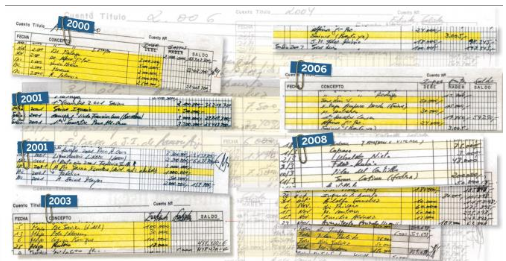
In case you are new to the story please consider Ledger Book Shows Rajoy Received 35 Payments Totaling €322,231; Rajoy's Incredulous Denial; Anger Rises

Next consider the amusing threats and carefully-crafted denials of the day as noted by the Huffington Post (Spanish edition) article "No Secret Book".
The PP extesorero exgerente and Luis Barcenas has said on Monday that the secret papers released last week by the newspaper El País are "blatant manipulation".

"There has not been a secret book ", [Barcenas] told Antena 3 on the door of his home, located in one of the most luxurious areas of Madrid. Barcenas has revealed that his lawyers are preparing lawsuits against media outlets that have posted entries.

Within hours of the country publish the secret documents that linked much of the dome of the PP with the collection of bonuses in black, Barcenas issued a statement assuring that in the years when he was manager and treasurer of the PP never realized leaders payments not covered by accounting officially declared , nor was any record of inflows or outflows of funds other than those stated.

FULL STATEMENT OF Luis Barcenas

"Given the news published in different media and particularly in today's edition of the newspaper" El País "hereby means I come to reveal the following:

  1. In the years when I was manager and later treasurer's Party, never carried or me or any other person record of inflows or outflows of funds other than those officially declared by the party.
  2. At least during the said period, never delivered any of the persons mentioned by the newspaper "El País", or any other amounts that have not been appropriately reflected in the only existing accounts in the Party.
  3. Throughout the repeated period, there was also in the party donation or contribution that did not meet any applicable regulations and / or was not properly reflected in the accounts of the Party and entered in the current account of donations.
  4. In strict compliance with the Act, the accounts of the Party was always presented to the Court of Auditors for audit, that court issuing appropriate reports throughout the said period blameless in the matter.
  5. Never in the many years of service I had the honor to play in the Popular Party consented, I hosted or perform any action that might involve a breach of the Act or the strict ethical principles of the Party.
  6. Whenever I tried to act with the utmost transparency in managing revenues and expenses of the party, as I know Lapuerta also made Alvaro, and if I make a mistake-as-I certainly was not getting any money or taking accounting parallel other than the only one existing in the Party.
  7. I reserve all legal actions, civil and criminal, amparen me to the manifest contempt for the truth and to me that is being carried out by those released to the public today falsehoods as those collected by "The Country".
  8. Finally I wish to record my deep expresses regret at the unfair damage you want to do with these false information to people who, with Mariano Rajoy at the front, I've always shown a high moral, professional and personal, blameless.

Mish Comments

  • I accept the fact there is "no secret book". It has been published and thus is no longer a secret.
  • Reserving legal actions is pointless. Unless newspapers knowingly published a false book, charges are ridiculous.
  • If Barcenas can prove he legally acquired the money for the slush fund, he should do so immediately.
  • If Rajoy can prove he paid taxes on the amounts received, he should also do so immediately.

Whether you are new to the story or not, let's review comments I made earlier today in Ledger Book Shows Rajoy Received 35 Payments Totaling €322,231; Rajoy's Incredulous Denial; Anger Rises
Curious Defense

Well here we are again, with a sideshow on whether the money was declared or not. Moreover, and more importantly, with all the names and dates, it should be known 100% without a doubt whether the entries are accurate or not.

If indeed Rajoy, did declare all the income, then it should be easily seen in tax records. So what did Rajoy declare on taxes?

Do the numbers match? If not, why not? Instead we have a pair of sideshows regarding a font and whether or not the money was declared.

If the documents were fake, would the matter need to be studied or would the PP would come straight out and declare, "the documents are fake"?

Moreover, if the documents were fake (and perhaps even if they weren't, it would be in Bárcenas' best interest to challenge their authenticity.

So, where is the statement from Bárcenas that they are fake?

Instead, Bárcenas threatened to set off a political "atom bomb" if convicted. If everyone is innocent, then it is logically impossible to set off a political bomb of any size, let alone an "atom bomb".

Simply put, the denials do not add up.

For more on the scandal, the denials, the "atom bomb" threat, and Rajoy's effort to squash the news, please see Big Brother in Action: EU Wants Power to Sack Journalists; Prime Minister Rajoy Threatens Newspapers Following Corruption Articles.
Another Sideshow Diversion

We now see yet another diversion attempt. This time the diversion is "There has not been a secret book".

This distraction attempt follows Rajoy's diversionary tactic regarding "undeclared money",  preposterous lawsuit threats by Rajoy and Bárcenas, and the PP wanting an investigation to see if the documents are real (even though neither the PP nor Rajoy denied their authenticity).

Once again I point out the laughable notion is that the published Bárcenas documents are fake. Seriously, wouldn't Bárcenas know? And if they were fake, surely Bárcenas would make that claim.

Yet, here we are with the PP demanding an investigation as to whether or not the documents are fake, with denials of "secret" books, and with smoke-blowing lawsuit threats.

The smoke, intimidation tactics, and outright lies have likely just begun. If this all sounds too familiar it's because it is familiar.

Richard Nixon: "I am not a crook".
Bill Clinton: "I did not have sex with that woman".

Mike "Mish" Shedlock
http://globaleconomicanalysis.blogspot.com

Ledger Book Shows Rajoy Received 35 Payments Totaling €322,231; Rajoy's Incredulous Denial; Anger Rises

Posted: 04 Feb 2013 11:39 AM PST

Rajoy Denies Receiving "Undeclared" Money

After waiting for days to make a statement, prime minister Mariano Rajoy stepped up to the plate with a fuzzy denial on Saturday following an emergency meeting of the Popular Party's executive committee.

"This is all false. I'm not in politics for money. I have never received undeclared money" said Rajoy.

Questions Abound

  • Where did the slush fund money come from?
  • Who were the recipients?
  • What were the totals?
  • Were the payments legal?
  • Did Rajoy really pay taxes on all of it?

The reference to "undeclared money" went away in firmer denial  from Rajoy, "Never, I repeat never, did I receive or hand out black money, not in this party nor anywhere else".

I am not positive of the order of those denials, but based on article timestamps, I believe I have them in the right order.

Adding fat to the denial fire, accounting books allegedly written and kept by Luis Bárcenas, the former PP treasurer, implicate Rajoy personally, to the tune of €322,231.

Meanwhile, anger is mounting and police barricaded the PP headquarters in response to gathering groups of protesters.

Anger Rises

The Financial Times reports Anger rises as scandal rocks Rajoy
Mariano Rajoy waited more than two days to comment on the slush fund scandal threatening to engulf both the Spanish prime minister and his Popular party. When the denial finally came, it was firm and unequivocal. "Never, I repeat never, did I receive or hand out black money, not in this party nor anywhere else," Mr Rajoy declared over the weekend.

Reminding Spanish voters of his decision to drop a lucrative career as a property notary decades ago, Mr Rajoy said on Saturday: "I didn't enter politics to make money. I entered politics losing money."

His assurances, however, did nothing to silence the rising popular anger over alleged secret payments to senior members of Mr Rajoy's centre-right Popular party, which has been rocked by a stream of embarrassing revelations over the past days. Hours after he spoke, riot police cordoned off the streets around the PP headquarters in central Madrid in preparation for the latest in a wave of small but widespread demonstrations against political corruption.

Asked whether they approve of Mr Rajoy, 77 per cent of Spaniards say no. The poll appeared alongside a fresh batch of revelations, after the paper decided to publish extensive excerpts of accounting books allegedly written and kept by Luis Bárcenas, the former PP treasurer. According to the latest report, the books record 35 payments to Mr Rajoy himself worth a total of €322,231 between 1997 and 2008.
Document Snapshot

La Razon reports The PP will commission a survey of the supposed "roles" Barcenas


In the alleged notes of former PP treasurer Luis Barcenas striking that the font is the same for all entries, which would mean that he would have written Barcenas year after year with the same layout. It is as if the author had aimed names and figures in one sitting all data as belonging to different dates and spaced in time.

Documents Real?

Press Euro reports 'The PP demands expert analysis of the Bárcenas documents to prove they are fake'
Prime Minister Mariano Rajoy's People's Party (PP) wants to submit the original copies of the secret financial notes alleged to have been written by his former treasurer, Luis Bárcenas, to experts in order to determine whether they are genuine.

According to the account records, published by El País, key members of the PP received additional undeclared payments between 1990 and 2008. Mariano Rajoy has said publicly that he has "never" received any undeclared money ...
Curious Defense

Well here we are again, with a sideshow on whether the money was declared or not. Moreover, and more importantly, with all the names and dates, it should be known 100% without a doubt whether the entries are accurate or not.

If indeed Rajoy, did declare all the income, then it should be easily seen in tax records. So what did Rajoy declare on taxes?

Do the numbers match? If not, why not? Instead we have a pair of sideshows regarding a font and whether or not the money was declared.

If the documents were fake, would the matter need to be studied or would the PP would come straight out and declare, "the documents are fake"?

Moreover, if the documents were fake (and perhaps even if they weren't), it would be in Bárcenas' best interest to challenge their authenticity.

So, where is the statement from Bárcenas that they are fake?

Instead, Bárcenas threatened to set off a political "atom bomb" if convicted. If everyone is innocent, then it is logically impossible to set off a political bomb of any size, let alone an "atom bomb".

Simply put, the denials do not add up.

For more on the scandal, the denials, the "atom bomb" threat, and Rajoy's effort to squash the news, please see Big Brother in Action: EU Wants Power to Sack Journalists; Prime Minister Rajoy Threatens Newspapers Following Corruption Articles.

Mike "Mish" Shedlock
http://globaleconomicanalysis.blogspot.com

Robot Wars in China; Burger Flipping Robots Serve 360 Gourmet Burgers an Hour

Posted: 04 Feb 2013 01:04 AM PST

With increasing frequency I see articles on how robots are taking jobs once held by humans. Typically I batch a few of them up for comments, and I have a new set now.

Last week, on the manufacturing front I reported "Baxter" the Robot Out to Get Your Minimum-Wage, No Benefits, Part-Time Job, Because He's Still Much Cheaper; Fed Cannot Win a Fight Against Robots.

Alpha the Custom Burger Flipping Robot

Here is a similar story in the service industry to consider: Robot Serves Up 360 Hamburgers Per Hour
Alpha machine from Momentum Machines cooks up a tasty burger with all the fixins. And it does it with such quality and efficiency it'll produce "gourmet quality burgers at fast food prices."

With a conveyor belt-type system the burgers are freshly ground, shaped and grilled to the customer's liking. And only when the burger's finished cooking does Alpha slice the tomatoes and pickles and place them on the burger as fresh as can be. Finally, the machine wraps the burger up for serving.

Alpha churns out a painless 360 hamburgers per hour. Saving money with Alpha is pretty easy to imagine. You don't even need cashiers or servers. Customers could just punch in their order, pay, and wait at a dispensing window.

For their next model Momentum Machines plans on adding a custom meat grinding feature so it can mix different meats – 1/3 pork, 2/3 bison sounds like a tasty combo – in the same burger. They'll also give it gourmet cooking abilities that seasoned chefs use such as charring the burger while retaining its juiciness.

The company plans on launching the first ever restaurant chain with a cook staff made entirely of robots. But not only might we soon find Alpha's creations at local burger joints, but the company is also targeting convenience stores, food trucks, and somehow even vending machines.

Robot Wars in China

China Daily reports Chinese robot wars set to erupt
Recent research conducted by the consultancy Ernst & Young LLP suggests that the average annual labor cost per worker rose to more than 40,000 yuan ($6,400) in 2011, from less than 25,000 yuan five years ago.

Given the context, it's easy to calculate the tradeoffs of getting a robot. "In fact, industrial robots are already cheaper than workers in China's eastern regions," said Wang Tianmiao, who heads the expert panel of robot technology under the State High-Tech Development Plan.

Wang said a typical industrial robot costs around 300,000 yuan and has annual maintenance costs of 20,000 yuan. The total layout of 500,000 yuan over 10 years is considerably less than that for a 6,000-yuan-a-month technician, and robots can work three times more efficiently.

Technology Kills Middle-Class Jobs

Yahoo! News reports Recession, tech kill middle-class jobs.
Five years after the start of the Great Recession, the toll is terrifyingly clear: Millions of middle-class jobs have been lost in developed countries the world over.

And the situation is even worse than it appears.

Most of the jobs will never return, and millions more are likely to vanish as well, say experts who study the labor market. What's more, these jobs aren't just being lost to China and other developing countries, and they aren't just factory work. Increasingly, jobs are disappearing in the service sector, home to two-thirds of all workers.

They're being obliterated by technology.

Year after year, the software that runs computers and an array of other machines and devices becomes more sophisticated and powerful and capable of doing more efficiently tasks that humans have always done. For decades, science fiction warned of a future when we would be architects of our own obsolescence, replaced by our machines; an Associated Press analysis finds that the future has arrived.

"There's no sector of the economy that's going to get a pass," says Martin Ford, who runs a software company and wrote "The Lights in the Tunnel," a book predicting widespread job losses. "It's everywhere."

The numbers startle even labor economists. In the United States, half the 7.5 million jobs lost during the Great Recession were in industries that pay middle-class wages, ranging from $38,000 to $68,000. But only 2 percent of the 3.5 million jobs gained since the recession ended in June 2009 are in midpay industries. Nearly 70 percent are in low-pay industries, 29 percent in industries that pay well.

Experts warn that this "hollowing out" of the middle-class workforce is far from over. They predict the loss of millions more jobs as technology becomes even more sophisticated and reaches deeper into our lives.

The most vulnerable workers are doing repetitive tasks that programmers can write software for — an accountant checking a list of numbers, an office manager filing forms, a paralegal reviewing documents for key words to help in a case. As software becomes even more sophisticated, victims are expected to include those who juggle tasks, such as supervisors and managers — workers who thought they were protected by a college degree.
Seemingly, there is no end to this. Software robots handle voice activated queries and mechanical robots replace humans in manufacturing.

If a job is repetitive and programmable, a robot is out to get it. That even includes minimum wage jobs in manufacturing and in food service.

Mike "Mish" Shedlock
http://globaleconomicanalysis.blogspot.com

3.2.13

Mish's Global Economic Trend Analysis

Mish's Global Economic Trend Analysis


Rajoy Further Implicated in Scandal; Support Drops to 23.9% in Record Plunge

Posted: 03 Feb 2013 06:24 PM PST

Prime minister Mariano Rajoy is now personally implicated in the slush fund scandal in Spain. Via Google translate, please consider Rajoy and his family were paid with money from Gürtel travel
The front page of Monday's newspaper "La Gaceta" promises new revelations about political scandals that are playing close to the popular government of Mariano Rajoy.

The fore mentioned entitled 'A Rajoy also paid travel, "about a picture of the back of the highest representative of the Spanish.

"His wife, his son and personal assistant flew business class to Las Palmas with money Gürtel", added the subtitle, attaching notes as evidence under seal 'exclusive'.
That should not be a surprise, but what choices do voters have?

Please consider this choppy translation from El Pais: crisis and corruption lead to PP to lower expectations


At this time, there is a ruling party with almost hegemonic majority, allowing it to act with little parliamentary scrutiny and yet have an estimate of the single vote of 23.9%, the lowest of democracy, only one year after having swept the polls. In a month and has lost six points from more than 20 points overall, without stating whether touched and thoroughly. And in theory are almost three years to allow citizens to speak at the polls. Your vote expectancy is now almost three points below the result of the AP of Manuel Fraga , 1982, when the PSOE of Felipe González swept him with 202 deputies.
Political Party Descriptions

From Wikipedia, here is a description of the top political parties in Spain.


Who do voters trust?

No one. Worse yet, Rajoy and the EU have threatened journalists that do not toe the party line. It's 1984 in spades. For details, please see Big Brother in Action: EU Wants Power to Sack Journalists; Prime Minister Rajoy Threatens Newspapers Following Corruption Articles 

Mike "Mish" Shedlock
http://globaleconomicanalysis.blogspot.com

Extreme Sentiment: Barron's Cover "Get Ready for Record Dow - We Told You So"; Top Call

Posted: 03 Feb 2013 10:44 AM PST

Looking for extreme sentiment?
Look no further than the cover of Barron's magazine.


The cover speaks for itself, but check out some of the commentary in New Highs in Sight
The party is far from over. The early-year rally that on Friday took the Dow Jones Industrial Average to within 1% of its record high, set in 2007, could have a lot further to run. For starters, stocks aren't expensive. The Standard & Poor's 500 index is valued at about 14 times estimated 2013 profits and the Dow fetches less than 13 times projected 2013 earnings. At the market peak in 2007, the Dow traded for 16 times forward earnings. Given ultralow interest rates, the market multiple has room to expand even if earnings growth remains modest.

There's a huge amount of money that could shift into stocks because individuals until recently have favored bonds over equities, based on mutual-fund flow data. "If there is a great rotation going on from bonds to stocks, we may be only in the top of the first inning," says Jason Trennert, chief investment strategist at Strategas Research Partners in New York. Trennert cites the TINA -- or "there is no alternative" -- factor, as yield-starved investors move into stocks.  
First Inning?

For starters, are the forward earnings estimates any better now than they were in 2007?

Second,  let me point out that money does not flow from stocks to bonds or vice versa. For every buyer of stocks there is a seller, so the statement on rotation from bonds to stocks is point blank absurd. There can be a repricing of bonds, a repricing of stocks, a repricing of both, or a repricing of neither, but there is no flow.

Third let me ask "Does it get any more extreme than someone calling this the first inning after stocks have had more than a 100% rally in a few years?

Nonetheless, sentiment alone cannot time a top. Perhaps the DOW or the S&P do make new record highs. Regardless, this Barron's cover reminds me of a post I did back in 2005.

Home $weet Home

Back on June 7th, 2005 I put in a top call with help from Time Magazine. That top call was based on this cover.


Time Magazine went gaga over real estate on the June 12th issue, right at the very peak of the bubble. Congratulations must go out to Time Magazine for that fine achievement.


On March 26, 2005, in It's a Totally New Paradigm I posted this chart


Then when the cover of Time hit, I moved the arrow to the top. Check out the comments at the time.
Ron Shuffield, president of Esslinger-Wooten-Maxwell Realtors says that "South Florida is working off of a totally new economic model than any of us have ever experienced in the past." He predicts that a limited supply of land coupled with demand from baby boomers and foreigners will prolong the boom indefinitely.

"I just don't think we have what it takes to prick the bubble," said Diane C. Swonk, chief economist at Mesirow Financial in Chicago, who was an optimist during the 90's. "I don't think prices are going to fall, and I don't think they're even going to be flat."

"I look at this as a short-term investment," said Mr. Farquharson, 36, who works for a venture capital firm, "and plan to unload it as soon as things look dangerous."

Top Call  

Supposedly we are only in "the first inning" of a rally. Hmm. Are stocks supposed to rise 900% more? This may not be "the top" but it's close enough for me. I'm calling it.

Mike Shedlock / Mish
http://globaleconomicanalysis.blogspot.com/

2.2.13

Mish's Global Economic Trend Analysis

Mish's Global Economic Trend Analysis


Obamacare in Action: Retail Workweek Hits 3-Year Low

Posted: 02 Feb 2013 05:26 PM PST

Hooray! The economy is adding jobs (supposedly). However, few look at the quality of the jobs, and whether or not they are part-time.

Jed Graham has a nice post on Investor's Business Daily that describes what I have been saying for months: Obamacare has accelerated the trend towards part-time jobs. There are more jobs, but fewer hours in them.

Please consider Retail Workweek Hits 3-Year Low In ObamaCare Shift by Jed Graham.
The fly in the ointment of January's jobs report was the apparent shift to part-time work ahead of a key ObamaCare deadline.

Although retail payrolls grew by 32,600, total hours worked in the industry dipped, Labor Department data out Friday showed.

The explanation? Rank-and-file retail workers logged the shortest workweek since early 2010: just 30.1 hours, on average, vs. 30.4 in December.

Remarkably, aggregate hours worked in the retail sector fell below their January 2012 level, even though industry payrolls are up 200,000 over that period. A similar trend showed up in leisure and hospitality: January payrolls rose by 23,000 even as aggregate hours dipped 0.3%.
Not Unexpected

This Obamacare-sponsored shift toward part-time jobs is certainly not unexpected, at least in this corner.


Last Hurrah?

I challenge the notion the economy added 157,000 jobs last month. I also challenge 23,000 leisure and hospitality jobs, and I challenge the claim that retail payrolls grew by 32,600.

For three straight months the household survey is way out of line with the payroll survey. This past month the household survey showed a net gain of only 17,000 jobs (please see Last Hurrah for Jobs? for details)

Yes, many prior months were revised up. But where are we now, going forward?

If the economy really did add 157,000 jobs on the "strength" of part-time hiring, then this was the last hurrah. If not, then I expect those BLS revisions to be re-revised away and October or November was the last hurrah.

Mike "Mish" Shedlock
http://globaleconomicanalysis.blogspot.com

Yum! The McRib is Back, Get Yours Today (After You Find Out What's In It); The Secret's in the Sauce!

Posted: 02 Feb 2013 07:48 AM PST

McDonald's does an excellent job at promoting sandwiches on its menu.

Top on the list is the "McRib" which comes and goes in "limited time" offers. You can even use a McRib Locator to find out which chains have the delicacy.

Before you rush out of your house to get one, you may be wondering "What's in a McRib".

That's a good question and the Natural Society has the answer in McDonald's McRib Sandwich a Franken Creation of GMOs, Toxic Ingredients, Banned Ingredients.
The McRib is the result of intensive marketing by McDonald's. Utilizing the basics of supply and demand through creating scarcity over the McRib by only unleashing the culinary abomination for a fraction of the year that is only known once it is released, McDonald's fans have been known to 'hoard' McRib sandwiches and eat them in extreme excess.

But what's really inside the McRib specifically that makes it such a food abomination? Containing over 70 ingredients, the McRib is full of surprises — including 'restructured meat' technology that includes traditionally-discarded animal parts brought together to create a rib-like substance. Here's some of the disturbing substances found within the McDonald's McRib sandwich:

A flour-bleaching agent used in yoga mats

Out of the 70 ingredients that make up the 'pork' sandwich, a little-known flour-bleaching agent known as azodicarbonamide lies among them. At first glance, this strange ingredient sounds concerning enough to look into. After a little research, you will find that even mainstream media outlets have generated content revealing how azodicarbonamide is actually used in the production of foamed plastics. Foamed plastics like yoga mats and more.

What's more? In Australia and Europe, the use of azodicarbonamide as a food additive is banned. In Singapore specifically, use of this substance in food can result in a $450,000 fine and 15 years in jail. Thank you McDonald's for supplying the nation with such healthful ingredients.

'Restructured Meat' from Pig Heart, Tongue, Stomach

McDonald's McRib is famous in some circles for utilizing what's known as 'restructured meat' technology. Since McDonald's knows you'd never eat a pig heart, tongue, or stomach on your plate, they decided instead to grind up these ingredients and put them into the form of a typical rib. That way, consumers won't know what they're putting into their mouths. As the Chicago Mag reported, the innovator of this technology back in 1995 said it best:

"Most people would be extremely unhappy if they were served heart or tongue on a plate… but flaked into a restructured product it loses its identity. Such products as tripe, heart, and scalded stomachs…"

So in other words, it's not actually a rib. Instead, it's a combination of unwanted animal scraps processed down in major facilities and 'restructured' into the form of a rib. Then, 70 additives, chemicals, fillers, and GMO ingredients later, you have a 'meat' product that tastes like ribs.
Whopper Horsemeat

Surely Burger King is not tainted with such tactics. Or is it? For the answer, let's take a look at another report from the Natural Society: Burger King Admits Burgers Contain Horsemeat
In a piece of highly disturbing news, Burger King has now admitted after continuous denial that it has actually been selling UK customers both burgers and Whoppers that contain horsemeat. This admission comes just after The Guardian reports that Burger King reps offered a round of 'absolute assurances' to customers that it did not ever use horsemeat in its products.

A series of tests done on the burger products now reveal that Burger King has been issuing completely phony statements, with burgers made for the fast food chain from the Irish company Silvercrest containing measurable levels of horsemeat. It's important to note this is the same company that processes meat for Tesco, Asda, and the Co-op. The managers at Silvercrest have been revealed to be utilizing non-approved ingredients within their burger assortment – even for 'household brands'.

Burger King Admits Error

The Guardian reports Burger King reveals its burgers were contaminated in horsemeat scandal.
Burger King has revealed that some of its burgers were contaminated in the horsemeat scare, as the tainted food crisis threatened to undermine the confidence of consumers, and major retailers tried to protect their reputations.

As governments in Ireland, the UK and Poland, where a supplier used by Silvercrest for a year is thought be the source of the contamination, continued their investigations, Burger King admitted that, contrary to previous assurances made to it by Silvercrest, it too had now been linked to the scandal. Authorities insist there is no health danger to consumers.

Meanwhile Aldi UK became the first major retailer to suspend its contract with a British plant, Dalepak Hambleton in North Yorkshire, which, like Silvercrest, is part of the ABP Food Group, pending further investigations into why three of nine newly tested burger samples had traces of horse and pork DNA. The products were from stock withdrawn in recent weeks as a precaution but made since October, the company said.

Burger King said: "Our independent DNA test results on product taken from restaurants were negative for any equine DNA. However, four samples recently taken from the Silvercrest plant have shown the presence of very small trace levels of equine DNA. Within the last 36 hours, we have established that Silvercrest used a small percentage of beef imported from a non-approved supplier in Poland. They promised to deliver 100% British and Irish beef patties and have not done so. This is a clear violation of our specifications, and we have terminated our relationship with them."

Diego Beamonte, vice-president for global quality at Burger King, said the company was "deeply troubled by the findings of our investigation and apologise to our guests, who trust us to source only the highest quality 100% beef burgers. Our supplier has failed us and in turn we have failed you".
Surprise? What Surprise?

Is anyone surprised by this? I certainly am not.

Indeed, after reporting on the "Extra-Value" Horse-Burger at grocery chains in the UK and Ireland, I would have been surprised to find out that burger chains were not contaminated as well.

Heck, even before reading articles on contamination I would have been surprised.

The Secret's in the Sauce!

Inquiring minds might wonder "Just how does McDonald's get the McRib to taste so yummy?" That's a good question too, and I have two answers.

Some simply like azodicarbonamide, bleaching agents, tripe, heart, scalded stomachs, tongues, and other unwanted animal scraps restructured into the form of a rib.

For everyone else, "The secret's in the sauce!" (Just don't ask what's in it).

Mike "Mish" Shedlock
http://globaleconomicanalysis.blogspot.com

1.2.13

Mish's Global Economic Trend Analysis

Mish's Global Economic Trend Analysis


500,000 People Sign Petition Asking Prime Minister Rajoy to Resign

Posted: 01 Feb 2013 04:09 PM PST

The indignation of citizens over payouts and graft in Spain is highlighted by a flood of protests on Spanish social networks. A campaign on Change.org, a platform with 25 million registered has collected a record 500,000 signatures calling for the resignation of Prime Minister Marinao Rajoy.

Via Google translate from El Pais, please consider 500,000 People Sign Petition Asking Prime Minister Rajoy to Resign.
The indignation of the public by publication in the country of the secret papers of the PP extesoreros, reflecting payments to the party leadership, is flooding social networks with messages calling responsibilities to Prime Minister Mariano Rajoy. appear together under tags like # Rajoydimisión or # quesevayantodos , in addition to the proposal for this diary # lospapelesdebárcena s. This wave of criticism also translates into hundreds of thousands of citizens (over 500,000 in just over a day) have signed a petition asking for "the resignation of the leadership of the PP", including Rajoy, and "all who have received payments in black money ".

"I wish we lived in a democracy and could revoke the government for not fulfilling its election and alleged corruption cases like this," explains Pablo Gallego , petition drives the platform Change.org . This 24 year old from Cadiz that their initiative is collecting 40,000 signatures per hour, a pace that, if continued throughout the day, could mean reaching one million accessions this Saturday.

If that number is reached, Gallego with messages intended to go to the national headquarters of the PP in Madrid.
Tipping Point

As I have said repeatedly, one never knows when the tipping point is. However, given the combination of massive government corruption coupled with unemployment of 26.6% and youth unemployment of 56%, it is certain the tipping point will indeed be reached.

For more on the scandal and what the prime minister is doing to suppress reporting of the corruption, please see Big Brother in Action: EU Wants Power to Sack Journalists; Prime Minister Rajoy Threatens Newspapers Following Corruption Articles.

Mike "Mish" Shedlock
http://globaleconomicanalysis.blogspot.com

Last Hurrah for Jobs? Establishment Survey +157,000 Jobs; Household Survey +17,000 Jobs; Unemployment Rate +.1 to 7.9%; Unemployment +126,000

Posted: 01 Feb 2013 11:53 AM PST

Initial Reaction

The establishment survey reported a gain of  157,000 job this month.

However, for the third consecutive month, the household survey is much weaker than the headline number.

The household survey shows a gain of a mere 17,000 jobs. Last month the household survey gained only 28,000 jobs. The unemployment rate rose to 7.9%.

As measured by the household survey (the basis for the reported unemployment number) the number of unemployed rose by 126,000.

Note: The BLS did not produce its usual collection of graphs today that I normally include in this report.  I was scrambling to find them but the report has changed, perhaps just for this month.

Massive population adjustments may explain the lack of charts this month.

Census Adjustments

Last month I stated "In the last year, the civilian noninstitutional population rose by 3,766,000"
This month I report "In the last year, the civilian noninstitutional population rose by 2,394,000. That is a huge downward census adjustment.

December BLS Jobs Report at a Glance

  • Payrolls +157,000 - Establishment Survey
  • US Employment +17,000 - Household Survey
  • US Unemployment +126,000 - Household Survey
  • Involuntary Part-Time Work +55,000 - Household Survey
  • Baseline Unemployment Rate +.01 at 7.9% - Household Survey
  • U-6 unemployment +.00 to 14.4% - Household Survey
  • The Civilian Labor Force +143,000 - Household Survey
  • Not in Labor Force  +169,000 - Household Survey
  • Participation Rate +.00 to 63.6 - Household Survey


Recall that the unemployment rate varies in accordance with the Household Survey not the reported headline jobs number, and not in accordance with the weekly claims data.

Quick Notes About the Unemployment Rate

  • In the last year, those "not" in the labor force rose by 1,095,000
  • Over the course of the last year, the number of people employed rose by 1,714,000
  • In the last year the number of unemployed fell from 12,748,000 to 12,322,000 (a drop of 426,000)
  • Long-Term unemployment (27 weeks and over) was 4,708,000 a decline of 58,000
  • Percentage of long-term unemployment is 38.1%. Once someone loses a job it is still very difficult to find another.


January 2013 Jobs Report

Please consider the Bureau of Labor Statistics (BLS) January 2013 Employment Report.

Total nonfarm payroll employment increased by 157,000 in January, and the unemployment rate was essentially unchanged at 7.9 percent, the U.S. Bureau of Labor Statistics reported today. Retail trade, construction, health care, and wholesale trade added jobs over the month.

Click on Any Chart in this Report to See a Sharper Image

Unemployment Rate - Seasonally Adjusted


Average weekly hours remained flat at 34.4 hours. A year ago average hours were 34.5 hours. Average hourly earnings rose this month from $23.74 to $23.78.

Real wages have been declining. Add in increases in state taxes and the average Joe has been hammered pretty badly. For 2013, one needs to factor in the increase in payroll taxes for Social Security.

For further discussion of income distribution, please see What's "Really" Behind Gross Inequalities In Income Distribution?

BLS Birth-Death Model Black Box

The BLS Birth/Death Model is an estimation by the BLS as to how many jobs the economy created that were not picked up in the payroll survey.

The Birth-Death numbers are not seasonally adjusted, while the reported headline number is. In the black box the BLS combines the two, coming up with a total.

The Birth Death number influences the overall totals, but the math is not as simple as it appears. Moreover, the effect is nowhere near as big as it might logically appear at first glance.

Do not add or subtract the Birth-Death numbers from the reported headline totals. It does not work that way.

Birth/Death assumptions are supposedly made according to estimates of where the BLS thinks we are in the economic cycle. Theory is one thing. Practice is clearly another as noted by numerous recent revisions.

Birth Death Model Adjustments For 2012


Birth Death Model Adjustments For 2013


Birth-Death Notes

Once again: Do NOT subtract the Birth-Death number from the reported headline number. That approach is statistically invalid.

In general, analysts attribute much more to birth-death numbers than they should. Except at economic turns, BLS Birth/Death errors are reasonably small.

For a discussion of how little birth-death numbers affect actual monthly reporting, please see BLS Birth/Death Model Yet Again.

Household Survey Data


click on chart for sharper image

There were massive revisions in labor force statistics this month.

Last month I stated "In the last year, the civilian noninstitutional population rose by 3,766,000.

This month I report "In the last year, the civilian noninstitutional population rose by 2,394,000. That is a huge downward census adjustment.

Last month I reported "Year-over-year, those not in the labor force rose by 2,394,000
This month I report "Year-over-year, those not in the labor force rose by 1,095,000 to 89,008,000."

In the last year, the labor force rose by 1,298,000.

Decline in Labor Force Factors

  1. Discouraged workers stop looking for jobs
  2. People retire because they cannot find jobs
  3. People go back to school hoping it will improve their chances of getting a job
  4. People stay in school longer because they cannot find a job

Were it not for people dropping out of the labor force, the unemployment rate would be well over 10%.

Part Time Status (in Thousands)


click on chart for sharper image

There are 7,918,000 workers who are working part-time but want full-time work. This is a volatile series.

Table 15 BLS Alternate Measures of Unemployment


click on chart for sharper image

Table A-15 is where one can find a better approximation of what the unemployment rate really is.

Notice I said "better" approximation not to be confused with "good" approximation.

The official unemployment rate is 7.9%. However, if you start counting all the people who want a job but gave up, all the people with part-time jobs that want a full-time job, all the people who dropped off the unemployment rolls because their unemployment benefits ran out, etc., you get a closer picture of what the real unemployment rate is. That number is in the last row labeled U-6.

U-6 is much higher at 14.4%. Both numbers would be way higher still, were it not for millions dropping out of the labor force over the past few years.

Duration of Unemployment


Long-term unemployment remains in a disaster zone with 38% of the unemployed in the 27 weeks or longer category.

Grossly Distorted Statistics

Given the complete distortions of reality with respect to not counting people who allegedly dropped out of the work force, it is easy to misrepresent the headline numbers.

Digging under the surface, much of the drop in the unemployment rate over the past two years is nothing but a statistical mirage. Things are much worse than the reported numbers indicate.

The Last Hurrah?

For the third month in a row, the underlying numbers were weak. The revisions to the population statistics support some of the drop in the unemployment rate, but those adjustments are in the past.

The recent divergence between the household survey and the payroll survey will close. The question is which way. Given business hiring plans, Obamacare adjustments, and the increase in payroll taxes that will take 2% of consumer spending away from those who need it most, I expect this is the last hurrah for jobs.

For a look ahead to 2013, please see Small Business Owners' Hiring Intent Plunges to 2008 Lows; Don't Blame Sandy or Fiscal Cliff.

Mike "Mish" Shedlock
http://globaleconomicanalysis.blogspot.com

"Wine Country" Economic Conference Hosted By Mish
Click on Image to Learn More

French Retail Sales Drop 10th Month Accompanied by Sharper Drop in Employment; Italy Retail Sales Drop 23rd Month; Eurozone Sales Collapse 15th Month; Wholesale Prices Soar

Posted: 01 Feb 2013 01:00 AM PST

Is the worst over for the Eurozone? That's what the ECB and heads of state said at the recent economic summit in Davos.

I offer some economic reality.

Eurozone Sales Collapse 15th Month and Wholesale Prices Soar

The Markit Eurozone Retail PMI® shows Eurozone retail sales downturn extends to fifteenth month in January
Key points:

  • Rate of decline remains sharp despite easing since December
  • Sales growth resumes in Germany
  • Wholesale prices rise at fastest rate in ten months

Summary

Markit's Eurozone retail PMI® data for the opening month of 2013 signalled a fifteenth consecutive month-on-month decline in sales values, even after accounting for the post-festive slump in trading and a resumption of growth among German retailers.

The three largest Eurozone economies are covered by the retail PMI surveys. The German Retail PMI hit a seven-month high and rose above 50.0, signalling a return to growth following December's contraction. French retailers meanwhile saw another solid fall in sales at a rate broadly similar to that seen in the final month of 2012 (adjusted for seasonal influences). French retail sales have declined for a survey-record ten successive months. In Italy, retail sales fell for the twenty-third consecutive month, and the rate of decline remained severe despite easing since December.

The rate of wholesale price inflation accelerated further in January to reach a ten-month high, linked to suppliers passing on higher raw material costs. All areas of retail posted rapid increases in suppliers' prices except for clothing & footwear. Despite this, the value of retailers' new purchases fell sharply, as they aimed to minimise warehouse levels in the face of weak demand. Subsequently, the value of goods held in stock at retailers declined for the fifth month running, and at the fastest rate since August 2010. Pressure on retailers' gross margins remained intense, however, most notably in Italy.

The combination of falling sales, rising cost pressures and a margin squeeze resulted in a
further round of job cuts at Eurozone retailers, even after accounting for the usual post-festive reductions. Employment in the sector has fallen every month since April 2012, and the rate of decline accelerated to the fastest since last July. German retailers again bucked the trend, registering sustained workforce growth.
Italy Retail Sales Drop 23rd Month

The Markit Italy Retail PMI® shows further sharp drop in retail sales, despite reaching four-month high
Key points:

  • PMI rises for second straight month, but still signals steep contraction in sales
  • Sharpest drop in purchasing activity among retailers since August
  • Wholesale price inflation accelerates to 11-month high

Summary:

January saw a further deterioration in the health of Italy's retail sector, with decreased sales leading to another round of job cuts. Purchasing activity among businesses fell accordingly, contributing to a further reduction in stock levels. There was more bad news on the costs front, with purchases prices rising at the fastest rate in 11 months.

Italian retail sales continued to fall at a sharp monthly rate at the start of the year, as indicated by the seasonally adjusted PMI® posting at 37.5 in January. This extended the current period of contraction to almost two years. That said, the index was the highest in four months, having risen slightly from December's mark of 36.8.
Germany Returns to Growth

The Markit Germany Retail PMI® shows return to growth at start of year
Key points:

  • Marginal expansion of retail sales during January
  • Employment growth continues
  • Wholesale price inflation highest since April 2012

At 51.0 in January, the seasonally adjusted Germany Retail PMI recovered from the eight-month low of 47.6 posted during December. However, the month-on-month rate of retail sales growth was only marginal, in part reflecting reports by survey respondents of subdued underlying consumer demand at the start of 2013.

...but like-for-like sales are lower than one year earlier

The marginal rise in month-on-month retail sales contrasted with a decline on an annual basis registered during January. Latest data pointed to a moderate reduction in like-for-like sales compared with one year earlier, and the pace of contraction was the sharpest since May 2010. Moreover, the index was in negative territory for the first time in nine months.
January sales disappoint compared to targets

Actual sales in the German retail sector fell short of initial targets during January, as has been the case in each month since April 2012. Moreover, the degree to which sales were lower than expected was the most marked for one year.

Margins squeezed at slowest pace since May 2011, despite sharper pace of cost inflation. Gross operating margins in the German retail sector decreased for the twenty-sixth successive month in January. Average prices paid by retailers for their purchases increased for the thirty-seventh month running, and at the sharpest rate since April 2012.
French Retail Sales Drop 10th Month Accompanied by Sharper Drop in Employment

The Markit France Retail PMI® shows Decline in French retail sales extends to tenth consecutive month.
Key points:

  • Sales continue to decline at solid pace
  • Sharper fall in employment
  • Accelerated drop in purchasing

Summary:

Latest data pointed to another drop in French retail sales at the start of 2013. Falling for a tenth consecutive month, sales contracted at a solid pace during January. Purchase price inflation remained strong, maintaining pressure on gross margins. Retailers cut their purchasing activity at a sharper rate, leading to a faster decline in inventories of goods for resale. Employment meanwhile fell at the sharpest rate in five months.

The index measuring sales versus one year ago also pointed to a sharp decrease in the latest survey period. The annual rate of contraction was the most marked since October 2012.

French retailers signalled that the average price of their purchases continued to increase during January, which they mainly attributed to suppliers passing on higher raw material costs. The rate of purchase price inflation was similar to the strong pace recorded in December.

The value of goods ordered by French retailers for resale fell again in January, extending the current period of contraction to 16 months. The latest decrease was the sharpest since October 2012.

Comment:

Jack Kennedy, Senior Economist at Markit and author of the France Retail PMI, said:
"The new year failed to bring cheer to the French retail sector, with the downturn in sales extending to a tenth consecutive month in January. The deterioration in general economic conditions continues to weigh heavily on the retail sector, with consumers reining in spending and stores reporting decreased levels of footfall. There also seems to be no end in sight to the long-running theme of squeezed margins, reflecting a combination of strongly rising wholesale prices and the need to discount goods in an intensely competitive environment."
Worst of Everything

  • Sales are down year-over-year across the board 
  • Sales are down month-over-month except for a small rise in Germany 
  • Price inflation is up across the board 
  • Margin squeeze across the board 
  • Employment is down 
  • France is sinking into the abyss 
  • Italy already in abyss

But hey ... the worst is behind (or so they say).

Mike "Mish" Shedlock
http://globaleconomicanalysis.blogspot.com